


Executive Summary
Heavy manufacturers spent the last decade buying robotic welders and the next decade trying to feed them. The robots arrived faster than the prep work could keep up, and a basic operation that used to be a footnote on the production line — beveling — is now the bottleneck nobody planned for.
The math has changed. Carbide insert prices have climbed. Plate hardness has gone up. Skilled floor labor is harder to find and harder to keep. Meanwhile, the robotic welders waiting downstream don’t tolerate inconsistency the way a human welder does. A bevel that was “good enough” five years ago now produces a weld that fails inspection — or worse, fails in the field. This paper looks at why in-house beveling has quietly become one of the most expensive operations on the heavy-manufacturing floor, and why a growing number of manufacturers are pulling it out of their facilities entirely and routing it through dedicated specialists. The model has a name now — Beveling-as-a-Service — and the manufacturers using it are doing three things their competitors aren’t: freeing up CNC capacity for work that justifies the machine, removing a known liability vector from automated welding, and getting plate parts back faster than they could’ve ground them themselves.
The argument isn’t that beveling is hard. It’s that beveling done at scale, on the right equipment, by people who do nothing else — is a different operation than the one most plants are still running.
Robotic Welding Changed the Tolerances. Beveling Didn’t.
When a heavy manufacturer brings a robotic welding cell online, the first thing they discover is what their prep work was actually getting away with.
A skilled human welder is a remarkable compensator. He sees the V-groove in front of him, reads the gap, adjusts filament where the bevel is wide, slows down where it’s narrow, and produces a sound weld whether the prep was machine-perfect or done with an angle grinder by a tired operator on a Friday afternoon. Decades of heavy-equipment manufacturing have quietly relied on that human margin. It absorbed inconsistency in upstream operations and made the welder, not the bevel, the point of quality control.
Robotic welders don’t compensate. They run the program and produce whatever the prep work tells them to produce. A robot welding a slightly inconsistent V-groove will lay a slightly inconsistent bead, and on a load-bearing joint, “slightly inconsistent” is the difference between a part that passes inspection and a part that gets sent back — or worse, a part that ships and fails in the field.
This is the structural reality most heavy manufacturers walked into without seeing it coming. The capital case for robotic welding was straightforward: faster cycle times, lower labor costs, more output per shift. What the spreadsheets didn’t account for was that the entire upstream prep operation was suddenly being held to a tolerance no human-graded process was designed to meet.
The stakes vary by application, but they’re never small. A bad weld on a pressure vessel can rupture under load. A bad weld on a forklift mast can drop five tons. A bad weld on an excavator boom can fail mid-dig. These aren’t theoretical edge cases — they’re the reasons weld inspection exists, and they’re the reasons the legal exposure on a load-bearing weld can outlast the equipment by decades.
In other words: the same robots that were supposed to make heavy manufacturing cheaper made the prep work upstream of them more expensive. Not in dollars per part, necessarily. In the tolerance the prep work now has to hit, the cost of failing to hit it, and the operations on a typical shop floor that were never built to deliver that consistency at scale.
That’s the real shift this paper is built around. Everything that follows — the equipment math, the labor math, the logistics — flows from this one observation: heavy-manufacturing prep work is being asked to do something it was never designed to do, and the gap between what it can deliver and what robotic welding requires is where the next decade of operational pain is going to live.
Why In-House Prep Quietly Became Expensive
Most heavy manufacturers don’t have a single line item on their P&L called “beveling.” That’s part of why the cost has been so easy to ignore.
Weld prep gets distributed across half a dozen budgets — operator hours, machine time, tooling consumables, floor labor, downtime, scrap. Each one shows up somewhere reasonable on a monthly report. None of them, individually, looks alarming. Add them up, and a typical mid-sized plant is spending more on weld prep than it spends on any single piece of upstream machinery — without anyone being able to point at the number on a chart.
The reason the math has gotten worse over the last five years isn’t any single change. It’s three independent trends compounding.
The Tooling Side: Carbide Got Expensive
Tungsten carbide insert prices have risen sharply, driven by raw material costs and tightened global supply. For shops doing in-house milling on V-grooves, this isn’t a marginal pressure — it’s a recurring line item that’s roughly doubled in some grades over the past several years. The increase doesn’t just appear in the consumables ledger. It compounds whenever the plate gets harder, because hard plate eats inserts faster. Stainless, Hardox, duplex, and armor plate were always rough on tooling; at current insert prices, milling them in-house is closer to lighting money on fire than running a shop.
For facilities that built their internal beveling process around CNC milling, the operating cost has quietly reset upward. Most haven’t recalculated their per-part numbers since they did.
The Equipment Side: The CNC Was Never the Right Tool
A million-dollar machining center is built to hold tight tolerances on complex geometries — five-axis work, contoured surfaces, the kind of machining that justifies the asking price. Putting one to work on a straight V-groove is a category mismatch. The machine clamps a single plate, runs the cut, releases, and the operator loads the next one. Throughput on weld prep through a CNC is a function of clamp time, not cut time, and clamp time doesn’t scale.
Plants run this way because they already own the CNC. The capital was sunk years ago, the operator is already on payroll, and the work has to get done. From the inside, it looks like the cheapest option. From the outside — measured in machine hours redirected away from the work that justifies the CNC’s existence — it’s one of the most expensive operations on the floor.
The Labor Side: The Work Nobody Wants
The alternative to milling weld prep on a CNC is hand-grinding it on the floor. Hand-grinding with an angle grinder is loud, dusty, monotonous, and physically taxing. It maxes out at a depth of three-quarters of an inch under realistic conditions, depends entirely on the operator’s skill for straightness, and produces results that no two workers will reproduce identically. None of those are new problems. What’s new is the labor market underneath them.
Skilled floor workers are harder to recruit and harder to keep than they were a decade ago. The work people are willing to accept has shifted, and “stand at a grinder for six hours” is increasingly the kind of job people leave. Plants doing the math on hand-beveling now have to factor in not just the hours, but the attrition. A worker who quits over the grinding work takes between three and twelve months of replacement costs with them — recruitment, training, productivity ramp, and the operational hit while the seat sits empty.
The labor argument used to be about pay rates. Now it’s about who’s willing to do the work at any rate.
How the Three Compound
In isolation, none of the three trends is fatal. A plant could absorb more expensive carbide if labor stayed cheap. It could absorb labor scarcity if the equipment were efficient. It could absorb inefficient equipment if the prep work weren’t on a hard deadline imposed by downstream automation.
What’s happened over the last five years is that all three have moved in the wrong direction simultaneously, and the structural relief valve — the human welder absorbing variation downstream — got removed when the robots arrived. The result is a prep operation that’s costing more on the materials side, costing more on the equipment side, costing more on the labor side, and being held to a higher tolerance than it was ever asked to deliver before.
That’s the bleed. It’s not dramatic, it’s not obvious on any single P&L line, and it’s not getting better on its own.
What an Outsourced Beveling Operation Actually Looks Like
Once a manufacturer accepts that in-house prep has stopped working, the next question is what replaces it. The answer the industry has settled on — quietly, over the past decade — is a service category most plant managers have never heard called by its name: Beveling-as-a-Service.
The term is functional, not flashy. It describes exactly what it is: a dedicated specialist takes on weld prep as their entire operation, runs it on equipment built specifically for it, and returns finished plates to the manufacturer ready for welding. The plates leave the plant on a Tuesday and come back the following Monday, beveled, consistent, and routed straight to the welding cell.
This isn’t a new idea. The Europeans have run their heavy manufacturing this way for years. What’s new is that the conditions in U.S. plants have finally reached the point where the math works for everyone, not just the largest fabricators.
The Equipment Category That Made It Possible
The reason BaaS works is that beveling at scale isn’t a CNC problem. It’s a grinding problem.
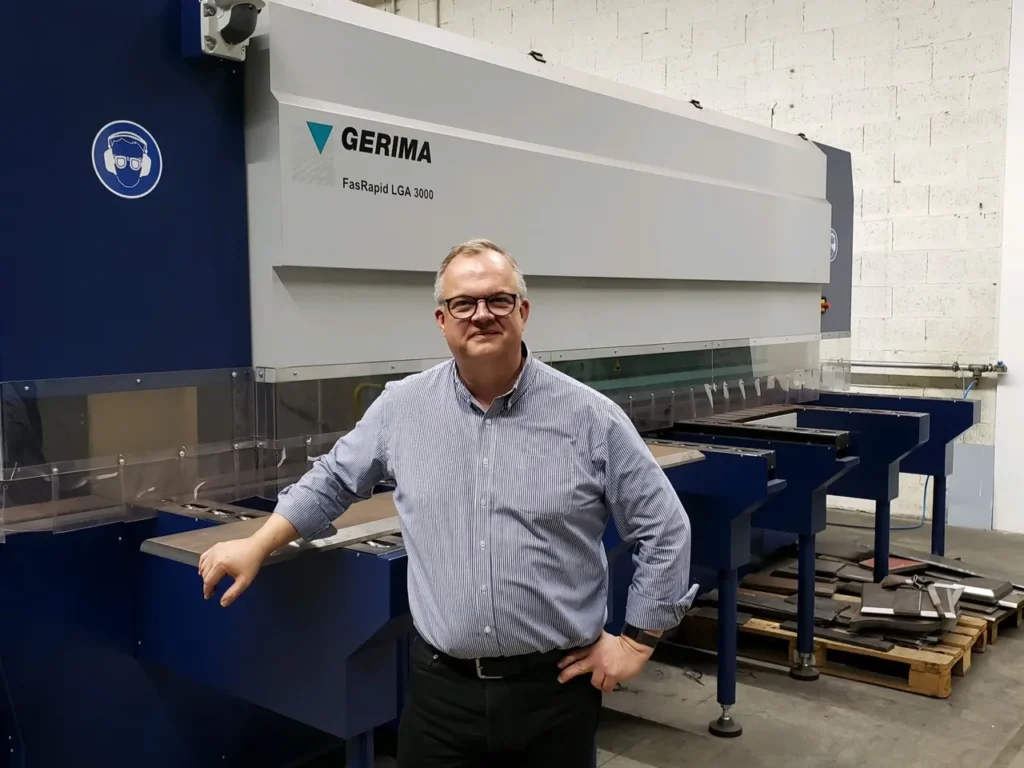
A purpose-built grinding beveler — the dominant machine class in this space comes from Gerima, the German manufacturer — solves the throughput math that defeats a CNC. Instead of clamping a single plate, milling a V-groove, releasing, and reloading, a grinding beveler accepts a stack of plates loaded into a single fixture. Up to twenty parts run through one operation. The grinding belt itself is the consumable, and it’s a fraction of the cost of carbide inserts, replaced on a regular maintenance cycle rather than chewed through under load.
The grinding process is also material-agnostic. Where a CNC operator looks at a stainless or armor-plate job and adds tooling cost to the quote, a grinding beveler runs A36 carbon steel and Hardox at the same rate, on the same equipment, with the same belt. The hardness of the plate doesn’t enter the cost calculation. For shops that have been quietly turning down hard-plate work because the in-house numbers don’t pencil, that’s a structural change to what’s quotable.
The capital cost of this equipment is meaningful — the larger Gerima machines run north of $650,000 each — which is precisely why it doesn’t make sense for individual manufacturers to buy them. A plant that bevels intermittently can’t justify the asset; a specialist running it across dozens of clients amortizes it across volume.
What the Specialist Does With Capital That a Plant Can’t
The economics of a dedicated beveling shop look different from the economics of a manufacturing plant for one specific reason: every dollar of capital expenditure is allocated against a single operation. A specialist isn’t choosing between buying a beveler and buying a five-axis machining center. They’re running a focused operation where the question is how many bevelers, how much redundancy, and how much headroom for surge capacity.
That changes what the specialist can responsibly invest in. A second machine purely for backup — sitting ready, kept tooled, switched on the moment the primary unit goes down for service — isn’t a luxury in a single-operation shop. It’s table stakes. A plant manager can’t justify buying two CNC machining centers to back each other up; a beveling specialist running production-critical work for downstream manufacturers can’t justify not buying two grinders. The customers’ deadlines don’t survive a breakdown otherwise.
This is the structural advantage that’s hardest to replicate in-house. A manufacturer who buys a single beveler is one breakdown away from the same in-house bottleneck they were trying to escape. A specialist holds the redundancy as a baseline cost of doing business, and the customer experiences it as something they never have to think about.
What the Specialist Doesn’t Do
A clean BaaS operation is also defined by what it refuses to take on.
The specialists running this model don’t buy raw steel, don’t warehouse it, and don’t broker it. They aren’t material vendors. The manufacturer or the Tier-2 processor procures the plate, owns the inventory exposure, and handles the steel-market price risk. The specialist receives the steel, bevels it, and ships it back. This separation of concerns — we machine; you supply — is what allows the specialist to keep capital and operational focus on the single thing they do well, and it’s what allows the customer to get a predictable price on the prep work without negotiating against a vendor who’s also speculating on commodity prices.
The same logic applies to scope. The grinders are built for plate steel, quarter-inch and up. They don’t bevel sheet metal, wire, tube, pipe, or round stock. A serious specialist will turn down jobs that fall outside that envelope rather than try to wedge them through. From the manufacturer’s perspective, that boundary reads as integrity rather than limitation. The specialist who’ll take any job is usually the one whose timelines slip when the jobs they shouldn’t have taken go sideways.
The Result From the Manufacturer’s Side
For the manufacturer, the change is simpler than the equipment story behind it suggests. The CNC machining center goes back to running the work it was bought for. The angle grinder goes back to the toolbox. The floor capacity that was being burned on weld prep gets reallocated to the work that earns the plant its margin. The carbide consumable line stops climbing.
What the plant manager actually notices first, though, is usually the silence. The work that used to generate constant friction — the prints sitting on a desk waiting to be quoted, the operators rotating off the grinder, the daily question of whether this week’s beveling will hold up production — disappears from the daily conversation. It’s been moved to a specialist whose entire operation exists to absorb it.
The manufacturer doesn’t get a better in-house process. They stop having an in-house process. That’s the actual shift.
Logistics, Geography, and the Real Reason Plants Hesitate
Most of the case for Beveling-as-a-Service is a math argument. The math is straightforward and the conclusion follows from it. But the math isn’t usually what stops a plant manager from making the switch.
What stops them is the truck.
When a plant manager sits with the BaaS proposal in front of him, the line that lands hardest isn’t the cost-per-part or the carbide savings. It’s and you’ll need to arrange freight. The math says outsource; the workday says find a trucker, write the bill of lading, watch valuable steel leave the dock, and trust someone he hasn’t met to handle a part with downstream value attached to it. Outsourcing the operation feels like outsourcing the control.
This is the part of the conversation that doesn’t show up in white papers, and it’s the part most worth being honest about.
The Hesitation Is Real, and It’s Not Irrational
The fear of letting a part out of the building isn’t financial — it’s procedural. A plant manager who’s run the same operation for fifteen years has built every contingency around what happens inside his four walls. He knows what to do when a CNC throws a fault. He knows who to call when an operator quits. He doesn’t yet know what happens when a truck loaded with $40,000 worth of plate doesn’t arrive at the bevel shop on schedule.
That uncertainty is reasonable. It’s also temporary. After a manufacturer has run two or three jobs through a specialist on the agreed timeline, the procedural unknown becomes a routine. The first relationship with any outsourced operation is the expensive one; every relationship after that is a workflow.
The honest argument isn’t that the friction doesn’t exist. It’s that the friction is finite — three or four cycles to absorb — and the structural cost of not absorbing it (carbide, CNC capacity, labor scarcity, robotic-welding tolerance) compounds indefinitely.
The Geography of It
The other half of the logistics question is where the specialist sits.
The U.S. heavy-manufacturing corridor is concentrated in a band running roughly from western Pennsylvania through Ohio, Indiana, Kentucky, Tennessee, and into Michigan and Illinois. A specialist sitting inside that corridor — Burlington, Kentucky, where Precision Bevel operates, is twenty minutes from Cincinnati and within a 500-mile radius of the bulk of that manufacturing base — can receive plates from most of its customers within a single day’s transit.
That geography matters because it changes the total cycle time math. A three-day turnaround on the grinder, plus one day of inbound freight and one day of outbound, comes to a working week. An in-house team grinding the same volume on existing equipment is typically two to three weeks. Even with freight added on both ends, the total elapsed time favors the specialist by a factor of two or three for any plant inside the radius.
The Routing Move Most Plants Haven’t Made
There’s a routing pattern that emerged organically among manufacturers who’ve been working with BaaS providers for a while, and it’s worth describing because most plants don’t realize it’s an option.
The conventional flow is: the Tier-2 steel processor cuts the plate to size, ships it to the manufacturer, the manufacturer ships it to the bevel specialist, the specialist ships it back, and the manufacturer welds it. Four legs of freight, three handoffs, and the manufacturer’s loading dock used twice for plates that don’t need to stop there.
The pattern that’s replaced it at facilities running this model long enough: the Tier-2 ships directly to the bevel specialist. The specialist ships finished parts directly to wherever the manufacturer needs them — their welding line, an end-customer, an assembly plant. The manufacturer’s loading dock isn’t a way station anymore. It’s a destination, only when the parts are headed there to be welded.
This routing — call it direct-ship, call it intercepted flow, call it whatever — removes a leg of freight, a handoff, and a chunk of administrative overhead. It also removes the psychological obstacle of the part leaving my dock, because the part never arrives at the dock to begin with. For manufacturers who’ve run a few cycles of conventional outsourcing and are ready to optimize, this is usually the next step.
What This Adds Up To
The argument for Beveling-as-a-Service isn’t an argument about technology. The grinders are what they are; the math on consumables is what it is; the labor market is doing what it’s doing. None of that is in dispute by anyone who’s looked at the numbers.
The argument is about which operations belong inside a heavy manufacturer and which don’t. For a long time, beveling sat in the inside column for default reasons rather than analytical ones. That default has been getting more expensive every year, and at some point it crosses a line where keeping it in-house is no longer the conservative choice — it’s the riskier one.
Heavy manufacturers don’t have unlimited capital, unlimited floor space, unlimited skilled labor, or unlimited tolerance for downstream liability. The decision to outsource an operation isn’t a decision to lose control of it. It’s a decision about where the manufacturer’s finite resources produce the most value, and beveling, on most plants’ floors, is no longer near the top of that list.
The question the next decade is going to ask isn’t whether Beveling-as-a-Service exists. It does, the model works, and the manufacturers using it are quietly running with structural advantages over the ones who aren’t. The question is whether a given plant moves on the math now, while it’s a planning decision, or later, when it’s a crisis decision driven by a missed deadline or a failed weld.
Most operational shifts in heavy manufacturing get made the second way. The ones who make them the first way are the ones who set the pace for everyone else.
